His Life · Chapter 6 of 8 · c. 1962 – 1963
Running for Office
In Klan-era Anniston, a year after the Freedom Riders’ bus was burned outside town, he ran for public safety commissioner and lost. His call for a biracial committee outlasted the campaign.
On Mother’s Day, May 14, 1961, a mob attacked a Greyhound bus carrying Freedom Riders at the Anniston station, followed it out of town and set it on fire on the Old Birmingham Highway. The photograph of the burning bus went around the world. For years afterward the town was known for that fire.
He did not deny it. Asked in 2002 whether Anniston belonged near the top of the list of Alabama’s troubled places, after Birmingham and Selma, he agreed.
“Yeah — it wouldn’t be one or two, but third is pretty high up. Oh, definitely, we had a problem.”
The campaign
In that climate Dr. Gordon Rodgers ran for public office. His obituary and an Anniston Star item preserved in Frederick Burger’s research file agree that the race was for Anniston’s public safety commissioner. The Star item dates it to 1962. The commissioner oversaw the city’s police.1 He lost.
He remembered his platform clearly.
“The Anniston Police Department always claimed to be fair-minded and enforce laws without any thought of the race of the people involved. And of course, everybody didn’t think that they were really doing that, but they made some efforts to do it, to enforce the law fairly. And I ran for public office back there, and that was one of my platform points — fair law enforcement for all people.”
A later magazine account of Anniston’s civil rights years adds another plank to that platform: a promise to create a biracial committee of white and Black community leaders to work toward civil rights reform. That history also says Rev. Nimrod Q. Reynolds campaigned for him. It describes the race somewhat differently, as a county contest, and gives vote percentages that have not yet been checked against election returns.2
The idea outlived the campaign. After more violence on Mother’s Day 1963, the city commission created the Anniston Human Relations Council on May 16, 1963. It had five white and four Black members, and Rev. J. Phillips Noble, pastor of First Presbyterian Church, served as chair. President Kennedy praised it as a model for the nation. Dr. Rodgers was not one of its nine appointed members. The magazine account credits his campaign’s call for a biracial committee as one of its inspirations; the city’s own marker does not mention him.3
At the Blair Hotel
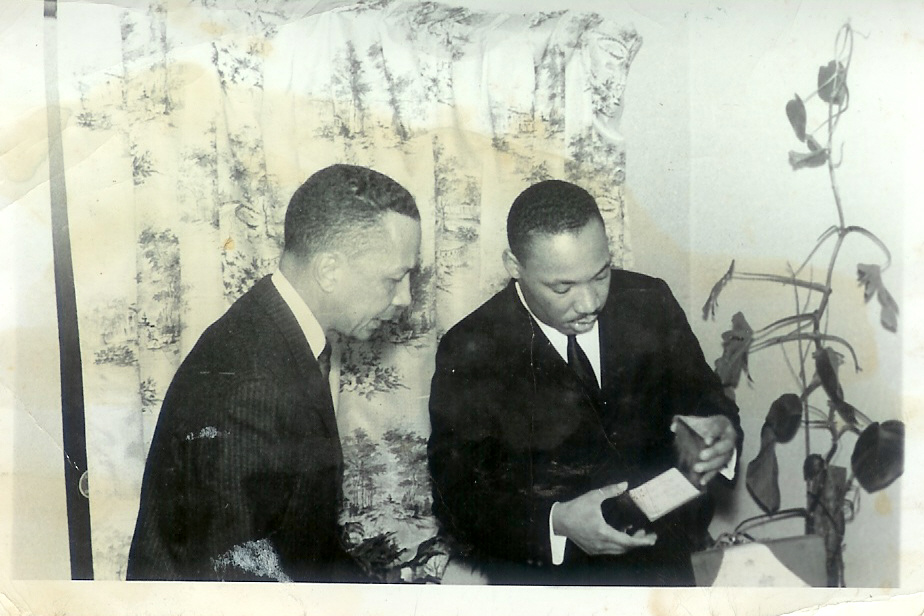
For decades the center of Black Anniston was West Fifteenth Street, which he remembered as “Big Fifteen,” with its hamburger places, shops and the Blair Hotel. The city’s own Civil Rights Trail marks the spot and records that Dr. Martin Luther King Jr. “held strategy sessions with Rev. Nimrod Q. Reynolds and Dr. Gordon Rodgers” there. The marker does not give a date.4
Asked in 1995 about Dr. King’s visits to Anniston, Dr. Rodgers answered simply.
“Well, yeah, we were real, real glad to have a big leader, Martin Luther King, come to our town, and see what we’re doing, and give us some encouragement to continue the task. Yeah, that made us all feel real good.”
The work went on at great cost. In September 1963, Reynolds and Rev. William B. McClain tried to integrate the Anniston public library and were beaten by a white mob. In July 1965 night riders shot and killed Willie Brewster, a Black foundry worker. Dr. Rodgers summed up that era in 1995 without drama:
“Back in those days somebody — the Ku Klux Klan — would shoot somebody every now and then because they didn’t like the way they were fighting segregation. But we didn’t give up — we just went right back to continue to fight. And the future looks better than it ever has.”
“About ten years later”
Losing did not end his political career. He summed up his record in two sentences.
“I ran once and I didn’t get elected, and then I ran another time about ten years later and I got elected.”
The newspaper record points to a shorter gap: a losing race in 1962 and a winning one in 1968.
Footnotes
-
William Thornton, “Gordon Rodgers, Anniston dentist, civil rights leader, activist dies at 92,” The Birmingham News, Dec. 27, 2007; Frederick Burger’s research notes cite The Anniston Star, “Today in History,” Oct. 21, 1998, p. 7E, “Rodgers running for public safety commissioner in 1962” (Burger research file, p. 2). In 1995 he placed his first race in “the early fifties,” and in 2002 he denied ever running for county commission. The 1962 date comes from the newspaper item. ↩
-
Andrew Dubbins, “The Radio Jock and Preacher Who Redeemed a Southern Town,” The Daily Beast. That account places the race in the county sheriff’s contest. The obituary and the 1962 Star item name the city public safety commission. We follow the two local sources until original election coverage is found. ↩
-
City of Anniston Civil Rights Trail, “Human Relations Council”; Dubbins, The Daily Beast. ↩
-
City of Anniston Civil Rights Trail, “West 15th Street Historic District”. ↩