His Life · Chapter 7 of 8 · 1968 – 1970s
First on the Council
In 1968 he became the first Black person elected to the Anniston City Council. He served two terms, and in 1971 he wrote the council's tribute to the minister who had chaired the Human Relations Council.
In 1968, three years after the Voting Rights Act, Gordon Rodgers ran again. This time he won. He became the first Black person elected to the Anniston City Council, and he served two terms.1
It surprised at least one person close to him. His niece, Frances Parker, told a reporter after his death:
“It surprised me that he got into politics. He always seemed content to serve his community, but politics meant that he was front and center. But that was another example of what he was willing to do.”
Frances Parker, quoted in The Birmingham News, Dec. 27, 2007
The Rev. Randy B. Kelley put it more directly: “He got into politics when it wasn’t popular to get into the ring.”
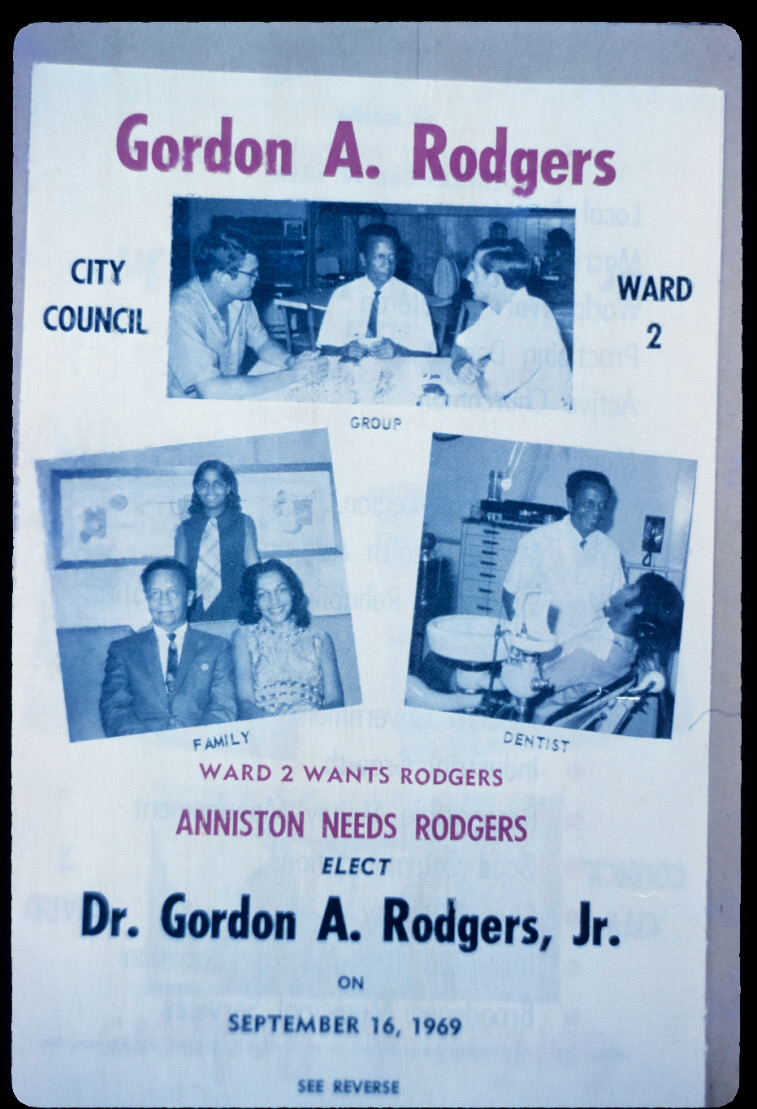
On the council
The fullest record of his years in office is still to be written. The council minutes and the Anniston Star’s coverage of those years have not yet been gathered for this site. One moment from his tenure is documented.
On July 20, 1971, the council honored the Rev. J. Phillips Noble. Noble was the white Presbyterian minister who had chaired the Human Relations Council in 1963, the body that, by one account, owed something to the biracial committee Dr. Rodgers had campaigned for nine years earlier. Noble was leaving Anniston, and the council’s resolution in his honor was written by Councilman Gordon Rodgers.2 The man who had called for a biracial committee from outside city government now thanked its chairman from inside it.
His own account of what he was for had not changed since the 1950s. It was the vote, and what the vote made possible.
“The attitude of the NAACP was to get people registered to vote, so that they can elect officials to run the government who will be fair, and help everybody without any consideration of what race you are.”
In those same years the NAACP honored him with lifetime-membership plaques, one in 1972 and another in August 1978, which he still had in 1995.3 A 1995 Columbus newspaper profile of his daughter Michelle Rodgers Sands described him in one line as the first Black member of the Anniston city council.4
Measuring it
Looking back in 1995, he refused to call the work finished or to call it a failure. He reached for a baseball comparison.
“A baseball player who gets a hit three hundred and thirty-three times out of a thousand times at bat is doing real well. So I guess we could measure civil rights accomplishments the same way — if you get a third of the things done that you planned on, that could be a favorable measurement of how well you’re doing.”
And he was clear about whose job the rest of it was.
“We can’t sit down here and drink coffee and ride in big cars and [expect] the change will automatically occur. We gotta roll up our sleeves and get with it.”
Did you know Councilman Rodgers, work at City Hall in those years, or keep clippings from his campaigns? The family would be grateful to hear from you.
Footnotes
-
William Thornton, “Gordon Rodgers, Anniston dentist, civil rights leader, activist dies at 92,” The Birmingham News, Dec. 27, 2007. Some other accounts give 1969, which may be the year he took his seat. ↩
-
Obituary of the Rev. Dr. James Phillips Noble, A.S. Turner & Sons, which describes Dr. Rodgers as “the first black person on the city’s governing board.” ↩
-
Alabama Oral History No. 93 (1995), Tape 4, 8:05–9:41. ↩
-
Linda Rosley Dailey, “Sands is driven to improve communities,” Columbus Ledger-Enquirer, Feb. 6, 1995, included in the JSU oral history documentation. ↩