Documents / 2007-12-27
“Gordon Rodgers, Anniston Dentist, Civil Rights Leader, Activist Dies at 92,” The Birmingham News
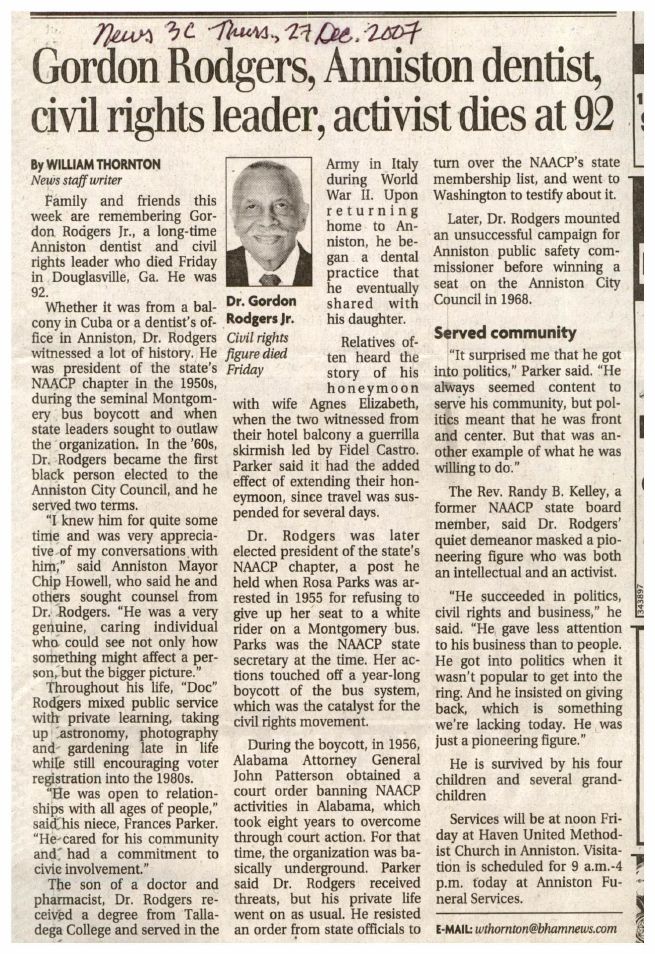
William Thornton's obituary, published the Thursday after Dr. Rodgers's death (the article says he died "Friday"). It is a key source for his later biography, including his years as state NAACP president, the 1956 ban, his unsuccessful run for Anniston public safety commissioner, and his 1968 election to the city council.
Full text transcription
Gordon Rodgers, Anniston dentist, civil rights leader, activist dies at 92
By WILLIAM THORNTON, News staff writer
Dr. Gordon Rodgers Jr. — Civil rights figure died Friday

Family and friends this week are remembering Gordon Rodgers Jr., a long-time Anniston dentist and civil rights leader who died Friday in Douglasville, Ga. He was 92.

Whether it was from a balcony in Cuba or a dentist's office in Anniston, Dr. Rodgers witnessed a lot of history. He was president of the state's NAACP chapter in the 1950s, during the seminal Montgomery bus boycott and when state leaders sought to outlaw the organization. In the '60s, Dr. Rodgers became the first black person elected to the Anniston City Council, and he served two terms.

“I knew him for quite some time and was very appreciative of my conversations with him,” said Anniston Mayor Chip Howell, who said he and others sought counsel from Dr. Rodgers. “He was a very genuine, caring individual who could see not only how something might affect a person, but the bigger picture.”

Throughout his life, “Doc” Rodgers mixed public service with private learning, taking up astronomy, photography and gardening late in life while still encouraging voter registration into the 1980s.

“He was open to relationships with all ages of people,” said his niece, Frances Parker. “He cared for his community and had a commitment to civic involvement.”

The son of a doctor and pharmacist, Dr. Rodgers received a degree from Talladega College and served in the Army in Italy during World War II. Upon returning home to Anniston, he began a dental practice that he eventually shared with his daughter.

Relatives often heard the story of his honeymoon with wife Agnes Elizabeth, when the two witnessed from their hotel balcony a guerrilla skirmish led by Fidel Castro. Parker said it had the added effect of extending their honeymoon, since travel was suspended for several days.

Dr. Rodgers was later elected president of the state's NAACP chapter, a post he held when Rosa Parks was arrested in 1955 for refusing to give up her seat to a white rider on a Montgomery bus. Parks was the NAACP state secretary at the time. Her actions touched off a year-long boycott of the bus system, which was the catalyst for the civil rights movement.

During the boycott, in 1956, Alabama Attorney General John Patterson obtained a court order banning NAACP activities in Alabama, which took eight years to overcome through court action. For that time, the organization was basically underground. Parker said Dr. Rodgers received threats, but his private life went on as usual. He resisted an order from state officials to turn over the NAACP's state membership list, and went to Washington to testify about it.

Later, Dr. Rodgers mounted an unsuccessful campaign for Anniston public safety commissioner before winning a seat on the Anniston City Council in 1968.

Served community

“It surprised me that he got into politics,” Parker said. “He always seemed content to serve his community, but politics meant that he was front and center. But that was another example of what he was willing to do.”

The Rev. Randy B. Kelley, a former NAACP state board member, said Dr. Rodgers' quiet demeanor masked a pioneering figure who was both an intellectual and an activist.

“He succeeded in politics, civil rights and business,” he said. “He gave less attention to his business than to people. He got into politics when it wasn't popular to get into the ring. And he insisted on giving back, which is something we're lacking today. He was just a pioneering figure.”

He is survived by his four children and several grandchildren.

Services will be at noon Friday at Haven United Methodist Church in Anniston. Visitation is scheduled for 9 a.m.-4 p.m. today at Anniston Funeral Services.

E-MAIL: wthornton@bhamnews.com
William Thornton, The Birmingham News, December 27, 2007. Via the Burger research file. View the original at The Birmingham News.